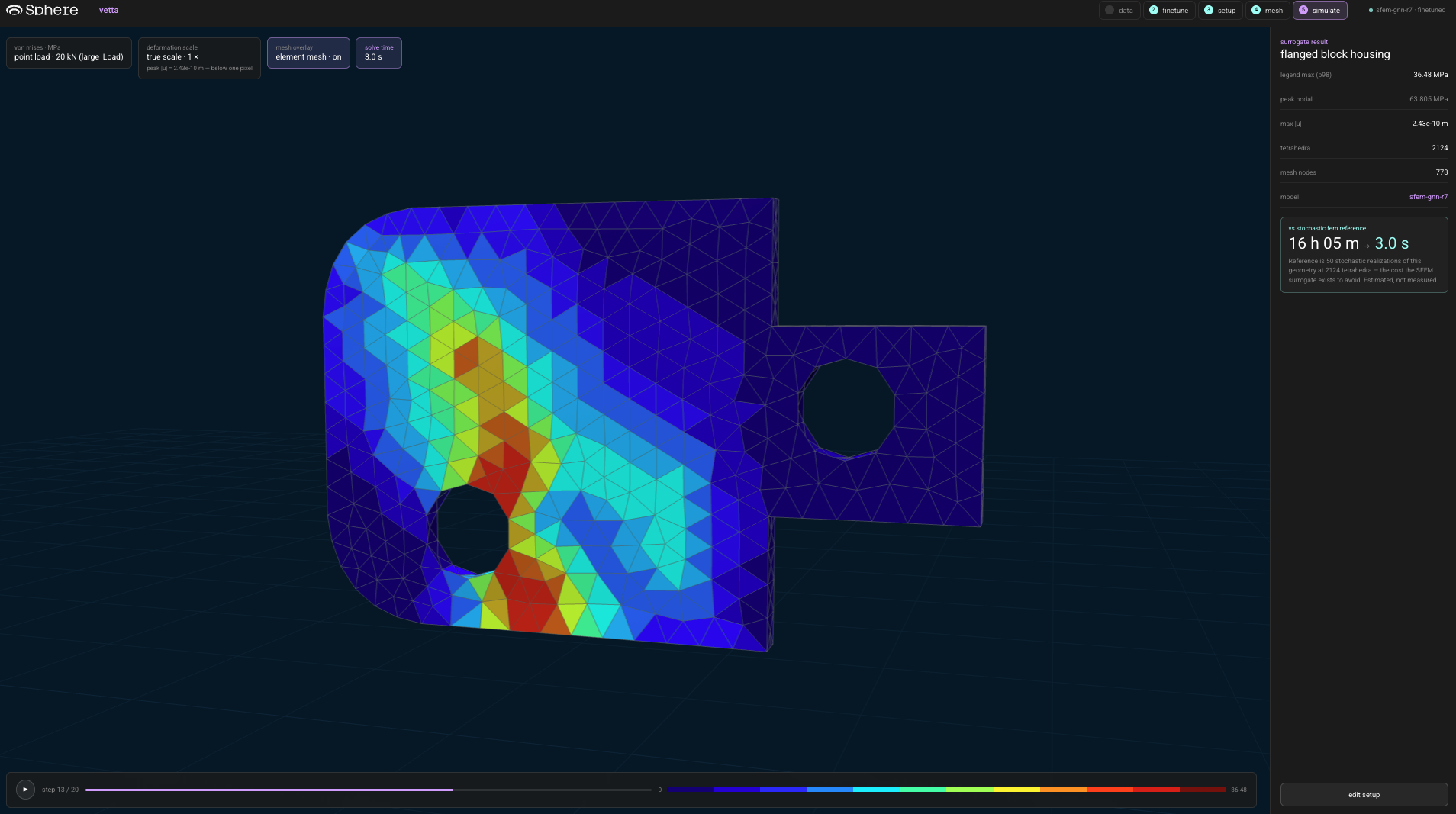
FEM surrogate simulation

Surrogate modeling

Accelerate your simulation iterations from hours to milliseconds.

  • 10,000xfaster execution than traditional FEA solvers
  • <5%error margin against ground-truth baseline runs
  • Sub-second inferencefrom parametric input to full 3D stress field
  • 100%of the design space explored, not just the safe bets

Your CAD model is ready. Your solver queue is not.

Compute clusters are bottlenecked, licensing costs are capped, and parameter sweeps take days to complete. The geometry sits in the PLM vault, waiting for an overnight batch run just to tell you the bracket is 2mm too thin. Every design iteration is gated by heavy numerical integration, so optimization is truncated by project deadlines, and the truly innovative geometries are never tested at all. Nothing tells you how much better the design could have been.

This is not a design failure. It is a computation bottleneck.

Simulate in seconds

Vetta leverages a surrogate model with a built-in physical grounding component to run FEM simulations in seconds rather than hours. Replacing traditional HPC infrastructure with hardware accelerators like GPUs allows Vetta to deliver high-accuracy results significantly faster.

One model. Real-time physics feedback.

Vetta reads your historical solver data: stress fields, deformed meshes, boundary conditions, and geometric variations: and learns the underlying mechanics of your components. Every new design is passed through a proprietary neural architecture that bypasses traditional meshing and matrix inversion, predicting full-field physics instantly. The engineer evaluates thousands of iterations interactively instead of waiting for a single run, and every prediction arrives with full 3D contours and a localized confidence score.

features

What your team

can do with it

01

zero-shot training from your historical runs

Wires your solver share, material library, and past DoE results into a unified training pipeline. Loads legacy stress fields, displacement maps, and boundary conditions to build the baseline physics model. Weights and embeddings are learned straight from your existing data exhaust, so no expensive new data-generation campaigns are required.

02

sub-second inference across the design space

Projects new CAD variations into the trained surrogate model to yield real-time von Mises, plastic strain, and displacement fields. The predictive envelope is evaluated in milliseconds, allowing engineers to slide through parameter ranges interactively, so the relationship between geometry and performance is visible instantly instead of hours later.

03

confidence mapping in the 3D geometry

Opens any surrogate prediction in the 3D viewport with an overlay of predicted error alongside the stress contours. The per-element confidence score marks where the model is interpolating safely and where it is extrapolating blindly, so the engineer knows exactly when a localized geometric feature requires a traditional, high-fidelity solver validation.

04

massive sweeps and inverse design

Ranks millions of generated geometric configurations by structural compliance or weight, with each parameter combination evaluated near-instantly. A thickened rib, a topological change, or a material swap is tested dynamically, and the optimal, lightweighted candidate is handed straight back to the engineer as a verified starting point.

Payback in months, not years

One unified engineering intelligence operating system

trained on your own geometry, process capabilities, and realized cost data, deployed securely inside your own infrastructure.

from days of compute to milliseconds of inference

millions of design iterations evaluated interactively

every prediction backed by a spatial confidence score

run a proof of concept