Physics-Inspired AI Crash Simulation for Automotive Safety Engineering
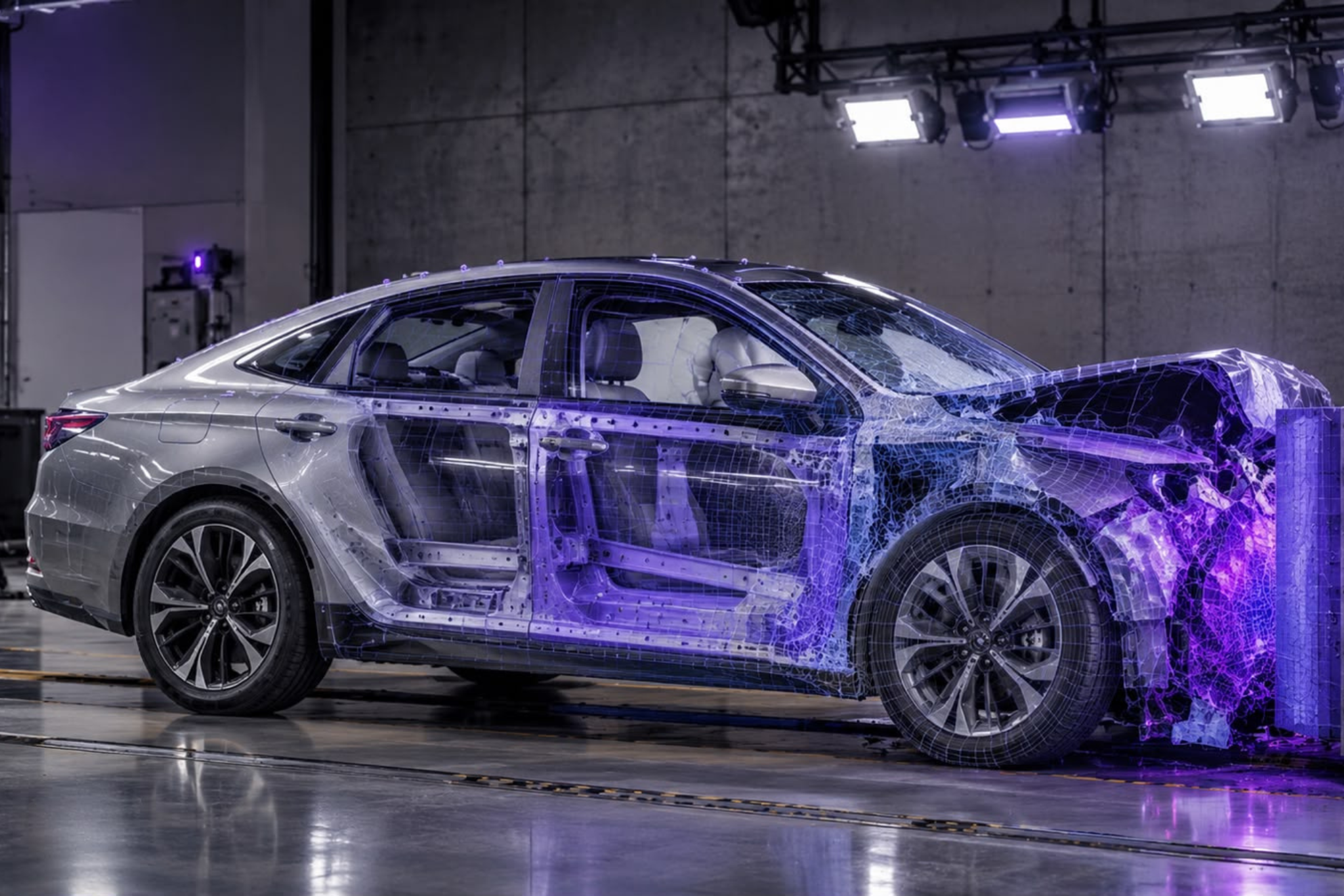
Automotive safety engineering team accelerating OpenRadioss FEA crash testing and real-time structural scenario modeling with millimeter-level accuracy.
The situation
Your crash safety engineers are constrained to limited test matrices due to computational bottlenecks.
Standard finite element crash simulations using solvers like OpenRadioss deliver high accuracy, but individual runs require hours of compute time. Consequently, engineering teams can only evaluate a limited set of impact conditions, angles, and speeds within their design windows, creating bottlenecks in design iterations and safety verification.
The approach
Physics-inspired surrogate models trained directly on internal compute infrastructure.
Sphere integrated OpenRadioss simulation data with physics-inspired surrogate architectures (inspired by NVIDIA NeMo) to train fast neural models directly on the client's internal architecture. Instead of replacing physics solvers, these surrogate models learn full deformation dynamics to predict structural crash behavior instantaneously.
To address surrogate uncertainty risks and ensure reliability, the framework incorporates two safeguards: automated anomaly detection within raw simulations and active out-of-scope safety boundaries. If an engineer attempts to run a model outside its validated training scope, the system automatically alerts the user and directs the run to full physics solver validation.
What changes for the engineer
Instead of waiting hours for a single OpenRadioss run, safety engineers evaluate dozens of crash conditions, velocity changes, and structural variations in seconds. When anomalies or unexpected physical behaviors occur, the system identifies errors in original simulation data and flags inputs exceeding surrogate boundaries, allowing engineers to explore vast design spaces rapidly while maintaining full confidence in crashworthiness.